
 Stylework Team
The corporate landscape has been fundamentally reshaped. The traditional model of a centralized headquarters is no longer the only path to success. Instead, a new imperative has emerged: the need to build, manage, and empower high-performing distributed teams.
This shift, accelerated by a massive global embrace of flexible work, presents both unprecedented opportunities and significant operational challenges. As enterprises navigate this dynamic world, they require agile infrastructure that supports talent wherever it exists.
The rise of remote work by 289% since 2019 is not a temporary trend but a strategic evolution, pushing companies to rethink their entire real estate and talent acquisition strategies.
The Evolution of Work: From Traditional Offices to Global Talent Pools
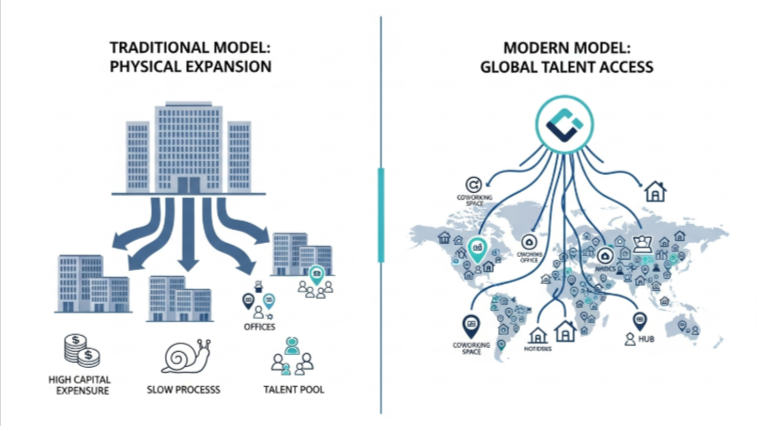
Historically, corporate growth was tied to physical expansion—opening new offices in major cities to tap into local talent. This model involved long-term leases, significant capital expenditure, and a slow, rigid process.
The modern economy, however, demands speed and adaptability. The shift towards remote and hybrid work has decoupled talent from geography, allowing enterprises to access a global pool of skilled professionals. This evolution moves the focus from owning physical buildings to providing access to productive, professional environments on demand.
Defining Distributed Teams in an Enterprise Context
A distributed team is more than just a collection of remote workers. In an enterprise context, it is a strategically designed workforce spread across multiple geographic locations. This can include employees working from home, regional hubs, or a combination of both.
Data shows that a significant portion of the workforce now operates under these models; in 2025, approximately 52% of remote-capable U.S. employees are hybrid. For an enterprise, a distributed team strategy is a deliberate choice to optimise talent acquisition, market presence, and operational resilience.

Why Multi-City Coworking Networks are the Strategic Enabler for Modern Enterprises
Enterprises require solutions that offer consistency, security, and scalability—attributes not always available through ad-hoc remote work arrangements. Multi-city coworking networks provide a powerful answer.
These networks offer a portfolio of professional, fully-equipped workspaces across various cities, managed through a single partnership.
This model allows enterprises to provide their distributed teams with consistent, high-quality work environments without the burden of managing multiple leases and properties. The global coworking market was valued at $22.01 billion in 2024 and is projected to grow, underscoring its increasing role as a core enterprise solution.
The Core Promise: Resilience, Agility, and Access to Talent
The fundamental promise of leveraging multi-city coworking networks is threefold. Resilience is enhanced by decentralising the workforce, reducing dependency on a single physical headquarters.
Agility is achieved through flexible terms that allow companies to scale their presence up or down in any city based on project needs or market shifts.
Finally, these networks provide a direct gateway to talent, enabling companies to hire the best people regardless of their location by offering them a professional, local workspace.
Also Read: Can Flex Workspaces Help You Meet ESG and Reporting Commitments
The Strategic Advantage of Multi-City Coworking Networks for Enterprises
Adopting a multi-city coworking strategy is not merely a real estate decision; it’s a competitive business strategy. It allows large organizations to operate with the agility once reserved for startups while maintaining the professional standards and infrastructure their scale demands.
Beyond Remote Work: Understanding the “Hub-and-Spoke” Model for Enterprises
Many enterprises are moving beyond a simple “remote vs. office” binary and adopting a “hub-and-spoke” model. In this structure, a central headquarters (the hub) is complemented by a network of smaller, flexible workspaces (the spokes) located in various cities.
These spaces, often situated within coworking spaces, serve as regional collaboration centers for distributed teams. This approach provides employees with the flexibility of remote work while still offering access to professional amenities, meeting rooms, and opportunities for in-person collaboration.
Unlocking Unprecedented Flexibility and Scalability
Traditional commercial leases are rigid, locking enterprises into long-term commitments that hinder rapid adaptation. Multi-city coworking networks shatter this paradigm.
They offer unparalleled flexibility, allowing a company to secure private offices for a small team in one city and on-demand access to meeting rooms in another.
This scalability is crucial for market entry, project-based work, and seasonal demands. An enterprise can test a new market with a small team without committing to a decade-long lease, de-risking expansion and enabling faster growth.

Expanding Talent Pools and Enhancing Employer Brand
The most significant competitive advantage in today’s economy is talent. By offering access to a network of coworking spaces, enterprises can attract and retain top professionals who may not live near a corporate headquarters. This widens the talent pool from a commutable radius to a national or even global scale.
Furthermore, providing a high-quality, amenity-rich workspace enhances the employer brand, demonstrating a commitment to employee well-being, productivity, and a modern work culture.
Offering these options has a proven effect, with 71% of leaders seeing a positive impact on employee happiness due to flexible work.
Driving Operational Efficiency and Cost Optimization
Multi-city coworking networks convert real estate from a capital expenditure (CapEx) to an operational expenditure (OpEx). This shift has profound financial benefits. Enterprises avoid the massive upfront costs of build-outs and long-term liabilities associated with traditional leases.
Instead, they pay a predictable monthly fee that covers rent, utilities, internet, security, and other amenities. This streamlined model simplifies budgeting, reduces administrative overhead, and allows for more efficient allocation of capital towards core business functions.
Also Read: Coworking Membership Models in 2026
Strategic Selection: Choosing the Right Multi–City Coworking Network Partner
Partnering with the right coworking network is critical to successfully implementing a distributed team strategy. The choice goes beyond finding available desks; it involves evaluating a provider’s ability to meet enterprise-grade requirements for security, infrastructure, and service consistency across all locations.
Defining Enterprise Needs: A Framework for Evaluation
Before approaching providers, an enterprise must first define its specific needs. This framework should include:
- Geographic Footprint: Identify the key cities and regions where talent exists or market expansion is planned.
- Space Requirements: Determine the mix of private offices, dedicated desks, and on-demand meeting rooms needed for different teams.
- Growth Projections: Forecast future scalability needs to ensure a potential partner can accommodate growth.
- IT and Security Protocols: Outline non-negotiable standards for network security, data privacy, and IT support.
Evaluating Coworking Providers and Models
Not all coworking providers are created equal. Enterprises should evaluate potential partners based on their ability to offer a cohesive, multi-city solution. A single, unified provider with a national or global network simplifies contracting, billing, and management.
This contrasts with a fragmented approach of managing multiple independent coworking spaces, which can lead to inconsistent experiences and administrative burdens. Look for providers specializing in enterprise solutions, as they better understand the needs of larger organizations.
Critical Infrastructure and Security Considerations
For any enterprise, data security is paramount. A suitable coworking partner must offer enterprise-grade IT infrastructure, including secure, high-speed internet, private VLANs, and robust physical security measures like access control and surveillance.
It is essential to conduct thorough due diligence on a provider’s security protocols to ensure they align with corporate compliance and data protection policies.
Amenities and Professional Environment: Supporting Productivity and Collaboration
The physical environment directly impacts productivity and employee satisfaction. A top-tier coworking network provides more than just a desk. It offers a suite of professional amenities, including fully-equipped meeting rooms, private phone booths, high-quality business lounges, and professional reception services.
The environment should be conducive to focused work while also fostering opportunities for networking and collaboration, creating a vibrant atmosphere that benefits employees and reflects well on the enterprise brand.
Operationalizing Distributed Teams: Seamless Integration and Management
Establishing a network of workspaces is only the first step. The real challenge lies in integrating these distributed teams into a cohesive, productive, and culturally aligned organization.
Onboarding and Integration for Distributed Employees
A standardized onboarding process is crucial for making distributed employees feel connected from day one. This process should include virtual orientations, introductions to key team members across locations, and clear documentation of company policies.
For employees using a coworking space, onboarding should also involve a seamless introduction to the physical workspace, ensuring they understand how to book rooms, access amenities, and connect with the local community manager.
Fostering Collaboration and Communication Across Time Zones
Effective communication is the lifeblood of any distributed team. Enterprises must invest in a robust technology stack that facilitates seamless collaboration. This includes high-quality video conferencing tools, instant messaging platforms, and project management software.
In fact, 37% of companies upgraded their video meeting tech in 2023 to better support distributed collaboration. Beyond tools, it’s vital to establish clear communication protocols, schedule regular team check-ins, and create intentional opportunities for virtual social interaction to build rapport.
Cultivating a Cohesive Enterprise Culture
Maintaining a strong company culture without a central office requires deliberate effort. Leaders must actively promote corporate values through consistent communication and recognition programs that celebrate achievements regardless of location.
Multi-city coworking spaces can play a role by hosting company-branded events or meetups for employees in the same city, blending virtual culture-building with valuable in-person connections.
Ensuring Data Privacy and Compliance in a Distributed Environment
Operating across multiple locations introduces complexities related to data privacy and regulatory compliance. Enterprises must work with their coworking provider to ensure all workspaces meet security standards.
Additionally, clear policies on data handling, device security, and use of public Wi-Fi must be communicated to all employees. Regular training and audits are essential to mitigate risks and ensure the organization remains compliant with all relevant regulations.
Maximizing ROI and Cost Management with Multi-City Coworking Networks
The financial benefits of using multi-city coworking networks extend far beyond simple cost savings on rent. A holistic view reveals a powerful model for maximizing return on investment and achieving greater financial agility.
Beyond Membership Fees: A Holistic View of Cost Savings
While the direct comparison of membership fees to traditional lease costs is favourable, the true savings are much deeper.
Enterprises save on capital expenditures for furniture and IT infrastructure, ongoing operational costs like utilities and maintenance, and administrative headcount for facility management.
This comprehensive cost avoidance model frees up significant capital and internal resources for investment in innovation and growth.
Quantifying the Return on Investment for Enterprises
The ROI of a multi-city coworking strategy can be quantified through several key metrics. These include reduced real estate TCO (Total Cost of Ownership), increased employee productivity, and lower employee turnover rates.
Studies have shown that effective strategic virtual engagement drives 25% higher output in distributed groups. By tracking these metrics, enterprises can clearly demonstrate the financial and operational value of their flexible workspace strategy.
Strategic Procurement and Partnership Models
Enterprises should approach coworking as a strategic procurement category. Negotiating a single master service agreement with a nationwide provider can unlock volume discounts, standardised terms, and simplified billing.
This partnership model provides cost predictability and operational consistency, allowing the enterprise to manage its entire distributed real estate portfolio through a single point of contact and a unified platform.
The Future of Enterprise Distributed Teams and Flexible Workspaces
The evolution of work is ongoing. The trends shaping the coworking industry and the technologies supporting distributed teams will continue to redefine the enterprise workplace.
Emerging Trends in the Coworking Industry
The coworking industry is maturing beyond offering just desks and Wi-Fi. The future lies in providing hospitality-driven experiences, wellness-focused amenities, and highly specialized environments tailored to specific industries.
Niche coworking spaces and an increased focus on sustainability are also emerging as key differentiators, offering enterprises more tailored solutions for their distributed teams.
The Role of Advanced Technology and AI in Managing Distributed Work
Technology will play an even greater role in managing distributed teams. AI-powered platforms will help optimize workspace utilization, predict future space needs, and personalize the employee experience.
Advanced collaboration tools incorporating AR/VR will create more immersive virtual meeting environments, further bridging the gap between physical and remote collaboration.
Anticipating the Next Evolution of the Multi-City Coworking Model
The coworking model will continue to evolve towards deeper integration with corporate clients. We can expect to see more “managed office” solutions where a provider designs, builds, and operates a fully-branded, private office space for an enterprise on flexible terms.
This hybrid model offers the best of both worlds: a customised, private environment without the long-term commitment and capital risk of a traditional lease.
Conclusion: Building an Agile, Resilient, and Talent-Rich Enterprise for Tomorrow
The transition to distributed work is no longer a question of if, but how. For enterprises aiming to thrive in a dynamic global market, building and supporting distributed teams is a strategic necessity.
Multi-city coworking networks have emerged as the critical infrastructure enabling this transformation. They offer a powerful solution that replaces the rigidity of traditional real estate with the flexibility, scalability, and efficiency required for modern business.
By strategically partnering with a unified coworking provider, enterprises can unlock significant advantages: accessing top talent from any city, optimising operational costs, and building a more agile and resilient organisation.
The implementation process requires careful planning—from defining needs and selecting the right partner to fostering a cohesive culture across locations. However, the return on this investment is clear.
It is about more than just providing a place to work; it is about designing a future-proof enterprise capable of attracting the best people and adapting to any challenge. The future of work is distributed, and multi-city coworking networks are the foundation upon which it will be built.