
 Stylework Team
Managing distributed teams across cities no longer means juggling dozens of landlords, leases, and invoices, here is how coworking aggregators change the equation.
Managing a growing workforce spread across cities like Gurugram, Bengaluru, and Mumbai traditionally requires heavy administrative overhead, multiple vendors, and strict legal lock-ins. The need for scalable distributed team office solutions has never been more urgent.
Coworking aggregators streamline this operational friction and act like a “corporate travel pass” for workspaces. Instead of signing separate leases in each city, your company signs one master agreement and accesses hundreds of multi-city workspace locations under that single umbrella.
| QUICK ANSWER |
| Coworking aggregators are platforms that consolidate workspace inventory from multiple operators across cities into a single contract, centralized billing system, and unified booking interface. For companies managing distributed team office solutions across Gurugram, Bengaluru, Mumbai, or globally, they eliminate vendor chaos and provide one multi-city workspace dashboard to manage it all. |
What Are Coworking Aggregators and How Do They Differ From Operators?
Before diving into the benefits, it helps to understand where coworking aggregators sit in the flexible workspace ecosystem.
A coworking operator (such as WeWork, Awfis, or CoWrks) owns and manages its own properties. If you sign with an operator, you access only their locations and their network has a ceiling.
Coworking aggregators such Stylework bring together spaces from multiple operators onto one platform giving companies access to a far broader multi-city workspace footprint under one contract.
| Feature | Coworking Operator | Coworking Aggregator |
| Inventory source | Own properties only | Multi-operator network |
| Contract structure | Per-location agreements | Single master agreement |
| Billing | Multiple invoices | Centralized monthly invoice |
| City coverage | Limited to their footprint | 120+ cities typically |
| Flexibility | Medium – tied to lease | High – monthly or on-demand |
| Compliance | Managed per city | Handled at aggregator level |
The aggregator model is particularly well-suited for distributed team office solutions involving 10-500 employees spread across cities who need workspace access without real estate management overhead.
5 Ways Coworking Aggregators Simplify Multi-City Office Management
1. Unified contracts and centralized billing
Instead of dealing with dozens of property managers and utility bills, organizations sign one master service agreement with coworking aggregators replacing an entire web of vendor dependencies.
- Expense tracking: All desk usage, office conference rooms, and private office bookings across regions are consolidated into a single monthly invoice.
- Simplified GST compliance: Legal and compliance work is handled at the aggregator level on navigating regional real estate laws city by city.
- Predictable budgeting: One recurring line item replaces dozens of unpredictable charges from individual operators.
2. Streamlined multi-city workspace bookings
- Coworking aggregators offer robust apps and dashboards that manage your company’s real-time multi-city workspace needs. Employees book instantly no calls, no guesswork.
- Instant booking: Reserve desks, private offices, or office conference rooms via the aggregator’s app from any city, on-demand or in advance.
- Access control: Admins set city and space-type entitlements per employee, managing everything centrally.
Also Read: Why Coworking Day Passes Are the Future of Hybrid Work
3. Scalable hub-and-spoke deployments
Coworking aggregators enable a hub-and-spoke model: a primary HQ with satellite access across cities without long-term lease commitments. This is the backbone of modern distributed team office solutions.
- On-demand scaling: Deploy a team into a managed workspace for three months, then scale back instantly.
- No Capex: Eliminate upfront spend on fit-outs and furniture. Pay only for what you use.
- No lock-in: Aggregator contracts are monthly or annual far more flexible than traditional 3-5 year leases.
| Real-world scenario A fintech start-up with a Bengaluru core team expanding to Delhi NCR can deploy 10 seats in a managed workspace in Gurugram within 48 hours no broker, no deposit, no fit-out. When the pilot concludes, they wind down with zero penalties. |
4. Consolidated data and analytics
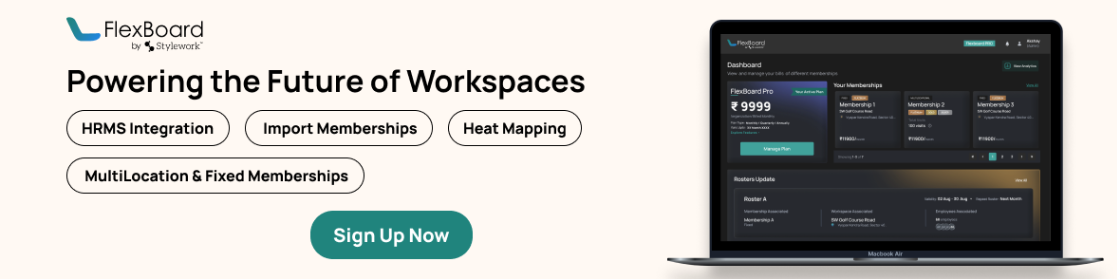
Once you sign a Coworking Master Service Agreement with an aggregator, you unlock access to coworking dashboards that give management clear visibility into how the multi-city workspace is utilized impossible to achieve when space is scattered across individual operators.
- Usage tracking: See which cities, buildings, or branches are most used and optimize accordingly.
- Cost optimization: Identify underutilized seats and reallocate budget in real time.
- Occupancy trends: Understand peak usage days to coordinate distributed team office solutions more smartly.
Also Read: How Enterprises Build Distributed Teams Using Multi-City Coworking Network
5. Standardized premium amenities
Top coworking aggregators ensure a consistent standard of amenities across all multi-city workspace locations with the same experience in Hyderabad as in Mumbai.
- Plug-and-play infrastructure: High-speed internet, secure access, mail handling, and community managers at every location.
- Reduced HR burden: Aggregators handle upkeep and facility management your teams focus on business, not office admin.
- Virtual office space add-ons: A registered business address and mail handling for remote employees needing a compliance address.
Who Benefits Most From Coworking Aggregators?
- Startups expanding to new cities: Access a multi-city workspace presence without committing to long leases during uncertain growth phases.
- Enterprise distributed teams: The ideal distributed team office solutions for 50-500 employees across multiple cities one contract, one invoice.
- Remote first companies: Give employees on-demand access to managed workspace or office conference rooms when needed.
- HR and admin teams: Eliminate the overhead of managing multiple vendor relationships, deposits, and maintenance issues.
How To Choose The Right Coworking Aggregators In India
Not all coworking aggregators are built the same. Evaluate potential partners on:
- City and building network: Verify actual coverage in your specific micro-markets not just the headline city count.
- Contract flexibility: Confirm monthly scaling options and exit terms. Avoid lock-ins beyond 12 months.
- Platform UX: Test the booking app before committing. Low adoption kills the value of any multi-city workspace solution.
- Virtual office space support: Confirm availability of a registered business address add-on for compliance needs.
- Amenity consistency: Request a walkthrough of partner space standards not just flagship locations.
- Dedicated account management: For teams of 20+, a dedicated manager is non-negotiable for your distributed team office solutions.
Platforms such as Stylework’s managed workspace network each offer distinct strengths; the right choice depends on your city mix, team size, and usage frequency.
Also Read: Why Multinational Companies Choose Coworking Spaces in Gurgaon
The Bottom Line
For any company managing a distributed workforce across Indian cities, coworking aggregators are fast becoming the default operating model for multi-city workspace management. One contract, one invoice, one platform and access to professional workspace wherever your people are.
Whether you are a 15 person startup testing a new market or a 300 person enterprise seeking scalable distributed team office solutions, the aggregator model offers a leaner, more flexible, and more data driven path forward.
Frequently Asked Questions (FAQs)
What are coworking aggregators?
Coworking aggregators are platforms that consolidate workspace inventory from multiple operators across cities into one contract, one billing cycle, and one booking interface.
What is the difference between a coworking space and a managed workspace?
A coworking space in India is shared by multiple companies in an open environment. A managed workspace is a private, dedicated office run by a third-party provider, and both are accessible through coworking aggregators.
How do coworking aggregators support multi-city workspace management?
They replace multiple vendor relationships with a single contract, giving distributed teams instant booking access, centralized billing, and usage analytics across all cities.
Can coworking aggregators handle distributed team office solutions?
Yes. They are purpose built for distributed team office solutions enabling companies to deploy, scale, or wind down workspace across cities without long term lease commitments.
Do coworking aggregators offer virtual office space?
Yes. Most offer virtual office space add-ons including a registered business address and mail handling ideal for remote employees or companies entering new state markets.
Can teams book office conference rooms through aggregators?
Yes. Employees can book office conference rooms on demand via the aggregator’s app such as Stylework across any city in the network, without separate coordination.
Why are some coworking spaces failing despite growing demand?
Individual operators face high fixed costs and thin margins. Coworking aggregators are insulated as they don’t own spaces if one partner closes, they simply reroute bookings to another location.