
 Stylework Team
Running a business is complex enough without getting buried under facility management, vendor coordination, and IT troubleshooting. Yet for most growing companies, a disproportionate amount of leadership time goes into keeping the office running rather than growing the business. That’s exactly why managed workspaces are becoming the go-to model for startups, SMEs, and enterprise teams alike.
By shifting the operational weight of office management to a dedicated provider, businesses can redirect energy where it truly counts: strategy, hiring, and growth. In this guide, we break down the real administrative challenges businesses face, how managed workspaces solve them, and why this model is fast becoming the default choice for modern organisations.
Administrative Challenges Businesses Face
Before you can appreciate what managed workspaces offer, it helps to understand what they’re solving. Office administration isn’t one problem; it’s a dozen overlapping ones that compound daily.
Managing Multiple Vendors and Office Operations
A traditional office runs on a web of vendor relationships: internet providers, cleaning agencies, security companies, HVAC contractors, pantry suppliers, and more. Each requires a separate agreement, invoice cycle, and point of contact. A single maintenance issue can mean calls to three or four parties before it’s resolved. This is workspace administration at its most exhausting.
Handling Workspace Allocation for Hybrid Teams
Hybrid work has transformed how teams use physical space. With employees splitting time between home and office, fixed seating models break down fast. Businesses without dedicated workspace tools end up managing allocation manually, spreadsheets, Slack messages, and ad-hoc seat assignments, none of which scale.
Meeting Room Coordination and Booking Issues
Double bookings, no shows, and rooms that sit empty while teams scramble for space are universal frustrations. Without a centralised booking system, office operations management becomes reactive rather than planned, eroding productivity and causing unnecessary friction.
Also Read: Meeting Room vs Conference Room
Infrastructure Maintenance and IT Dependency
In a traditional office, high-speed internet, video conferencing setups, access control systems, and printers are maintained by internal teams. When something breaks, the cost is both financial and operational. IT dependency is one of the highest friction administrative burdens small and mid-sized businesses face.
Tracking Workspace Utilisation and Operational Costs
How many desks are actually being used? Which floors are over capacity? What’s the cost per occupied seat this quarter? Most businesses simply don’t know because they don’t care, but because they lack the tools to measure it. Without visibility, office management services remain reactive and inefficient.
Managing Multiple Office Locations Manually
For businesses with offices across cities or countries, administrative complexity multiplies with each location. Policies, vendors, access systems, and reporting rarely align. What works in one city doesn’t automatically scale to another, and the cost of maintaining multiple leases manually is enormous.
Also Read: Why Startups Prefer Managed Office Space in 2026
How Managed Workspaces Reduce Administrative Burden
This is where managed office solutions fundamentally change the operating model. Rather than businesses managing office infrastructure themselves, a dedicated workspace provider takes ownership, letting internal teams focus on their actual work.
Reduced Facility Management Responsibilities
With a fully managed office space, providers handle daily maintenance, housekeeping, HVAC management, and utility coordination. There’s no internal facilities team to hire, no contractor to call when the AC fails, and no vendor invoice to chase. The workspace simply runs, and businesses are free to run their operations.
For most companies, this alone justifies the switch. Facility management is a full-time job. Managed workspace providers make it invisible.
Simplified Vendor and Billing Coordination
Instead of managing ten vendor relationships, businesses receive a single, consolidated monthly invoice covering everything: internet, cleaning, security, pantry, and maintenance. This shift to a single provider model is one of the most immediate administrative wins that flexible workspace solutions deliver.
It also eliminates the cognitive load of tracking renewals, renegotiating contracts, and onboarding new service providers every time a vendor relationship ends.
Also Read: Coworking Space in India: Complete Guide
Easier Hybrid Workforce Management
Modern managed workspaces are designed for hybrid teams. Employees can book desks, meeting rooms, or private offices on demand without involving an office manager or IT department. This empowers teams to plan their time independently while giving leadership real visibility into how space is actually being used.
Whether your team comes in three days a week or three days a month, workspace operations flex accordingly without administrative overhead.
Faster Business Scalability
One of the most underestimated costs of traditional offices is the friction involved in scaling. Adding headcount means renegotiating leases, reconfiguring layouts, sourcing new furniture, and upgrading IT infrastructure, all before the new hire even starts.
Managed workspaces eliminate this entirely. Businesses can scale up or down with minimal notice and zero renegotiation. It’s one of the core reasons growing companies choose managed offices: they need flexible workspace solutions that keep pace with their growth, not hold it back.
Lower Internal Administrative Dependency
When office management is outsourced to a provider, the internal headcount required to manage it shrinks. HR teams no longer spend half their day coordinating seat assignments. Operations leads aren’t chasing IT vendors. Leadership isn’t signing off on pantry purchase orders.
This reduction in internal administrative dependency is particularly valuable for lean teams, where every hour of leadership time has a measurable opportunity cost.
Also Read: How Managed Offices Are the Future of Flexi Workspaces
How FlexBoard Simplifies Workspace Operations
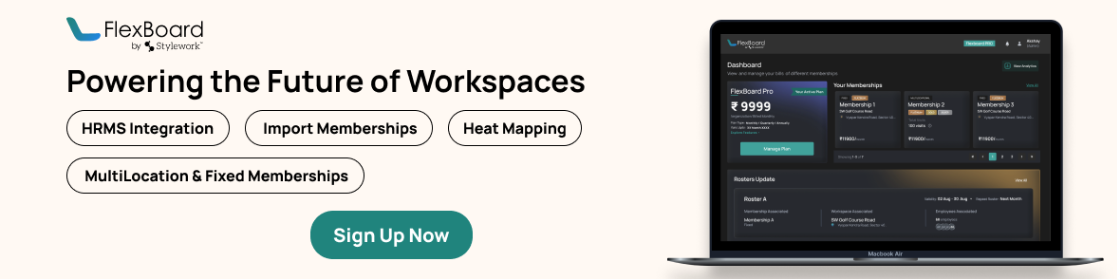
While managed workspaces reduce infrastructure and operational responsibilities, platforms like FlexBoard help businesses manage workspace operations more efficiently through centralised technology solutions.
Centralised Workspace Management
FlexBoard enables businesses to manage multiple workspace locations through a single dashboard. Companies can monitor workspace usage, manage employee access, and streamline workspace operations centrally. This improves operational visibility and reduces manual coordination across teams and locations.
Real-Time Booking and Access Management
Employees can book a dedicated desk, meeting room, or private office in seconds from any device, at any time. Booking conflicts are eliminated automatically. Access permissions are managed digitally, removing the need for physical keys or manual check-in processes.
For businesses operating across top coworking spaces, FlexBoard ensures that each location operates on a consistent, reliable booking system regardless of geography.
Better Reporting and Operational Insights
Modern businesses require data-driven workspace decisions. FlexBoard helps organisations track workspace utilisation, employee booking behaviour, and operational trends through centralised analytics.
These insights help businesses:
- Optimize workspace costs
- Improve utilization rates
- Monitor team preferences
- Plan workspace strategies efficiently
Streamlined Hybrid Team Coordination
Managing distributed and hybrid teams becomes easier with centralised workspace management platforms. FlexBoard helps businesses coordinate employee access, approval workflows, and multi-location workspace operations from a single system.
This reduces manual intervention and improves operational efficiency for hybrid workforce management.
Also Read: Optimize Your Hybrid Workplace with Stylework’s FlexBoard
Why Businesses Are Adopting Managed Workspace Models
Businesses today are prioritising flexibility, operational efficiency, and scalability. Managed workspaces support these goals by reducing infrastructure responsibilities and simplifying workplace operations.
Key benefits include:
- Reduced administrative workload
- Faster scalability
- Better operational efficiency
- Flexible workforce management
- Lower infrastructure dependency
- Improved employee experience
As hybrid work models continue evolving, managed office solutions are becoming an essential part of modern workplace strategies.
Also Read: How a Managed Office Transformed a Business in Tier 2 Cities
The Future of Workspace Management
The next evolution in workspace management isn’t just about outsourcing facility operations; it’s about intelligence. AI-driven occupancy planning, predictive maintenance, automated vendor management, and dynamic space allocation are already becoming part of the managed workspace proposition.
Businesses that adopt managed workspaces today are not just reducing administrative burden in the present; they’re positioning themselves to benefit from the technology-first workspace management platforms that will define the next decade.
As hybrid work matures, the distinction between managed workspaces and traditional offices will grow sharper. Businesses operating on managed models will have lower overhead, more agile operations, and better access to data-driven decision-making than those still navigating the complexity of self-managed offices.
The future of workspace operations is not more internal complexity, it’s less.
Conclusion
Managed workspaces help businesses reduce administrative burden by simplifying facility management, vendor coordination, workspace operations, and hybrid workforce management. Instead of spending time on office-related tasks, businesses can focus on growth, productivity, and operational efficiency.
When combined with centralised workspace management platforms like FlexBoard, organisations can further streamline operations, improve visibility, and create a more scalable and flexible workplace strategy for the modern workforce.
Also Read: Why Managed Offices Are Gaining Popularity?
Frequently Asked Questions (FAQs)
What is a managed workspace?
A managed workspace is a fully serviced office environment where a dedicated provider handles all facility operations, including maintenance, IT infrastructure, cleaning, security, and vendor management, so businesses can focus entirely on their core work.
How do managed workspaces reduce administrative burden?
They consolidate all office-related responsibilities under a single provider, eliminating the need for internal teams to manage vendors, coordinate maintenance, handle billing, or oversee day-to-day facility operations.
Are managed workspaces suitable for small businesses?
Yes. Managed workspaces are particularly beneficial for small and growing businesses that don’t have the resources to hire a dedicated operations or facilities team.
Can managed workspaces support hybrid teams?
Absolutely. Most managed workspace providers offer on-demand desk and room booking systems that allow hybrid teams to plan their in-office days flexibly, without manual coordination.
What office management services are typically included?
Services generally include housekeeping, security, internet, meeting room access, pantry management, IT support, reception services, and a single consolidated monthly bill.
How does FlexBoard help with workspace operations?
FlexBoard provides a centralised platform for booking, access management, utilisation reporting, and hybrid team coordination, making workspace administration seamless across single or multiple office locations.
Can businesses scale up or down easily with managed workspaces?
Yes. Unlike traditional leases, managed workspace agreements are designed for flexibility, allowing businesses to add or reduce space with minimal notice and no long-term renegotiation.