
 Stylework Team
India’s accelerating Global Capability Centre ecosystem is quietly rewriting the playbook for flex-space companies and the numbers prove this is no passing trend.
What once catered primarily to freelancers and early stage start-ups has evolved into an enterprise-first business. Today, managed office contracts signed by multinational firms have emerged as the single biggest growth engine for India’s flexible workspace industry transforming how operators think, price, and deliver their services.
According to Financial Express, this shift has been building steadily over the last two years, driven directly by the rapid expansion of Global Capability Centres (GCCs) across Indian cities.
Traditional coworking hot desks, monthly memberships, and casual community events no longer define the sector’s direction. Flexible workspace operators are actively repositioning themselves as full-service enterprise real estate partners, bundling workspace design, fit-outs, IT infrastructure, F&B, and facility management under a single managed office agreement.
This is not incremental change. It reflects how global companies are now approaching office expansion in India. Multinational firms especially first-time Global Capability Centres entering the Indian market prefer a plug-and-play office solution that eliminates heavy capital expenditure and compresses go-live timelines significantly.
| 💡 How GCCs Typically Scale in IndiaMost first-time GCCs start with just 25-50 seats inside a managed flexible workspace.They gradually expand to 100-300 seats as their India operations mature.This avoids long-term direct lease commitments from day one. |
Also Read: Office Expansion in India for Enterprises & GCCs (2026)
Why the GCC: Managed Office Model Delivers Better Economics
For flex-space companies, enterprise managed office deals simply outperform conventional coworking on every key metric. Teams of 200+ seats typically sign three-to-four year lock-ins, resulting in lower client churn, higher revenue per seat, and stronger long-term occupancy visibility fundamentals that define a healthier, more predictable business.
Coworking vs. GCC Managed Office
| Metric | Traditional Coworking | GCC Managed Office |
| Contract Length | 1-6 months | 3-4 years |
| Revenue per Seat | Standard | Significantly Higher |
| Client Churn | High | Low |
| Occupancy Predictability | Volatile | Strong Visibility |
| Services Scope | Desk + Amenities | Full Enterprise Stack |
According to Financial Express, Awfis, one of India’s leading flex-space companies, reported that Global Capability Centres contributed 21% of space rental revenue in Q3 FY26, with 100+ seat clients averaging a tenure of 49 months. Smartworks entered FY27 with over ₹5,200 crore in contracted rental revenue locked in covering 82% of projected annual revenue while its GCC-linked revenue share doubled from 7% to 15% within a single year.
The Scale Driving This Structural Shift
| 1,700+ GCCs operating in India today | $64.6B GCC sector revenue FY24 | $105B Projected GCC revenue by 2030 |
| 2M+ Professionals employed in GCCs | 145M sq. ft Expected flex workspace by FY27 | 16-18% Projected flex inventory growth |
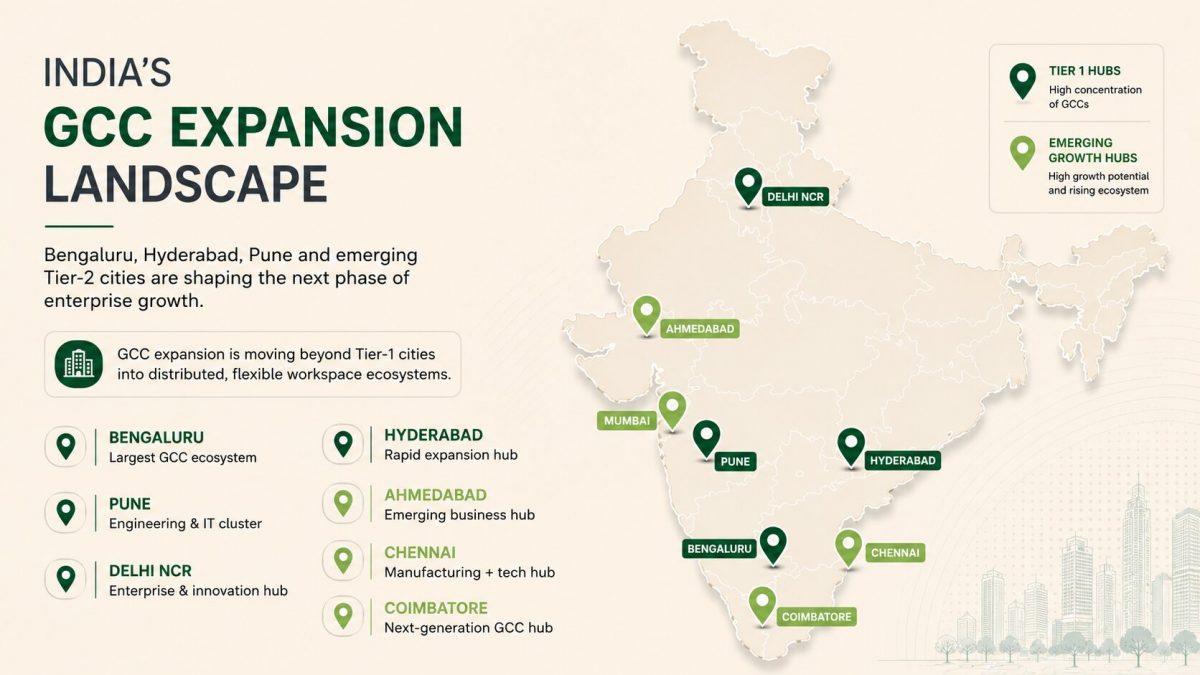
According to Financial Express, India’s GCC sector revenue climbed from $40.4 billion in FY19 to $64.6 billion in FY24, with projections pointing to $105 billion by 2030 across nearly 2,400 centres. This wave of GCC expansion is fuelling demand for enterprise workspace solutions across Tier 1 cities Bengaluru, Hyderabad, and Pune as well as Tier 2 markets through hub-and-spoke office models that balance scale with cost efficiency.
Flexible workspace inventory across India is expected to grow 16-18% to reach 140-145 million sq ft over the next two fiscal years, supported by sustained demand from GCCs, domestic corporates, and a growing hybrid workforce navigating multi-city operations.
Key Takeaways
- GCCs now drive managed office demand, replacing startups as the primary flex workspace client
- Managed office contracts deliver 3-4x longer tenure than traditional coworking
- Awfis and Smartworks are already generating 15-21% of revenue from GCC-linked contracts
- Tier 2 cities are the next frontier hub-and-spoke models are expanding beyond metros
- Flex workspace inventory is on track to hit 140-145 mn sq ft by FY27
A Structural Shift: Not Without Real Risks
The opportunity is genuinely compelling, but it is not without limits. As Global Capability Centres cross the 1,000 employee threshold, many begin transitioning to direct long-term leases, reducing their dependence on managed office operators. The model also demands significant upfront investment in fit-outs, technology, and working capital before contracts stabilize into consistent revenue streams.
| Risk to Watch Industry experts note that while GCC demand represents a genuine structural tailwind, flex-space companies that mistake this momentum for permanence risk being caught off-guard in the next cycle. Operators who over extend ahead of demand, or fail to retain enterprise clients as they scale, face meaningful downside. |
For flexible workspace operators that navigate this correctly, the payoff is significant: a move from transactional desk-rental businesses toward recurring, high margin enterprise workspace infrastructure partnerships with multi-year visibility.
The Opportunity Ahead
India’s GCC boom is offering flexible workspace operators a defining window to graduate from real estate vendors into genuine enterprise workspace infrastructure partners, purpose-built for office expansion in India at scale.
The companies that win will be those that treat GCC clients not as tenants, but as long-term growth partners designing spaces, services, and contracts that evolve as their India operations scale.
Frequently Asked Questions (FAQs)
Q: What is a Global Capability Centre (GCC) in India?
A: A Global Capability Centre (GCC) is an offshore unit set up by a multinational company in India to handle strategic business functions including technology, R&D, finance, AI, and operations. India hosts over 1,700 GCCs as of 2025, employing nearly 2 million professionals.
Q: Why are GCCs choosing managed office spaces over direct leases?
A: First-time and mid-market GCCs prefer managed office spaces because they offer plug-and-play infrastructure, faster go-live timelines, no heavy capital expenditure on fit-outs, and the flexibility to scale from 25-50 seats to 300+ as India operations grow without long-term lease commitments from day one.
Q: How is the GCC boom changing the economics of flexible workspace operators?
A: GCC-led managed office contracts offer flex-space companies higher revenue per seat, lower client churn, and 3-4 year lock-in periods compared to the short, volatile tenures typical in traditional coworking. This improves occupancy predictability and overall profitability significantly.
Q: Which cities in India are seeing the most GCC-driven flex workspace demand?
A: Tier 1 cities Bengaluru, Hyderabad, Pune, Mumbai, and Delhi NCR continue to lead. Tier 2 cities such as Jaipur, Indore, Kochi, and Coimbatore are also gaining momentum through hub-and-spoke office models that reduce costs while expanding talent access.
Q: What are the risks of the GCC–managed office model for flex operators?
A: The primary risk is scale-out: as GCCs grow beyond 1,000 employees, many shift to direct long-term leases, bypassing flex operators. The model also requires significant upfront capex in fit-outs and working capital before revenue stabilises.