
 Stylework Team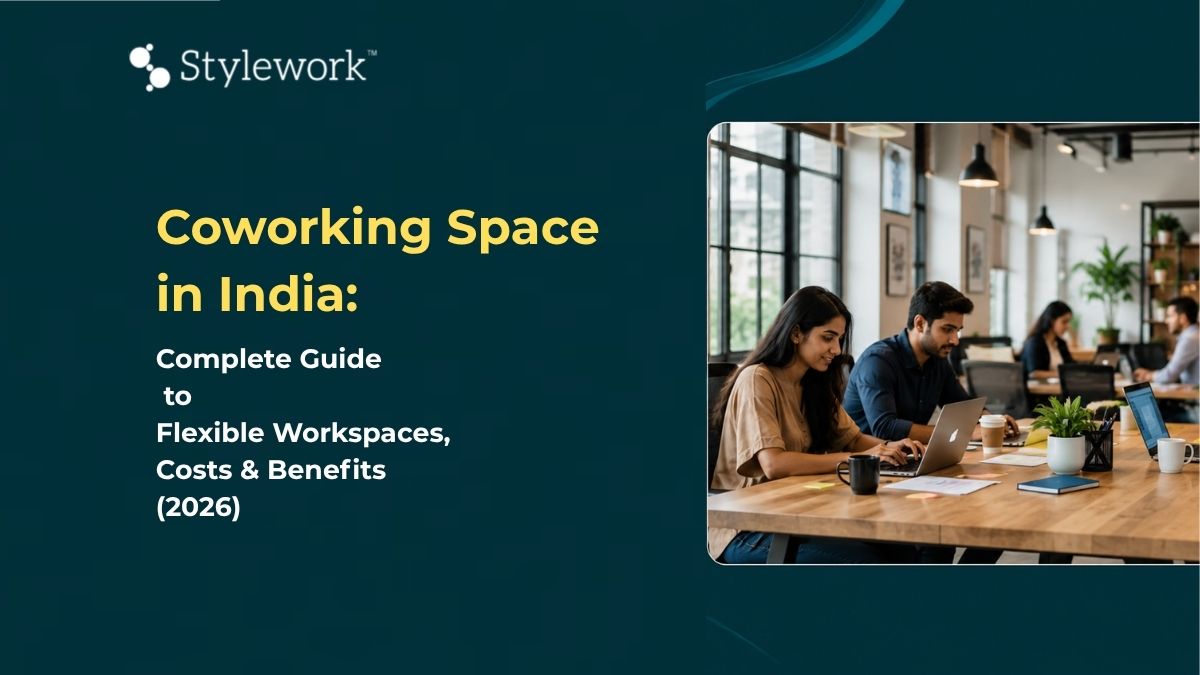
The way India works has fundamentally changed. What started as a niche concept for freelancers in metro coffee shops has evolved into one of the country’s fastest-growing commercial real estate segments. Today, coworking space in India serve start-ups scaling from 2 to 200 seats, MNCs setting up satellite offices, and Global Capability Centres (GCCs) deploying hybrid workforce models all without a single long-term lease commitment.
India’s flexible workspace stock crossed the 100 million sq ft milestone in 2025, reaching 110–114 million sq ft, according to a March 2026 FICCI–CBRE report, well ahead of earlier projections. The surge reflects how rapidly demand for coworking space in India has scaled. Operators are now spanning 120+ cities, from Bangalore’s Whitefield tech corridor to emerging Tier-2 markets like Indore, Coimbatore, and Lucknow.
| What is a Coworking Space? |
| A coworking space is a professionally managed, shared office environment where individuals and organisations work independently or collaboratively under a flexible membership model. Unlike traditional leases, members pay only for what they use: a desk for a day, a private cabin for a month, or a fully managed floor for a year with all infrastructure, utilities, and services included. |
| Key identifiers: shared amenities, no fit-out cost, flexible tenures, community programmes, and scalable seating options. |
How Coworking Space in India Works
A coworking space in India is a professionally managed facility where individuals and teams from different organisations share a common workspace, each paying only for their own desk, cabin, or floor.
The operator leases the real estate, fits it out, and absorbs the operational burden of power, housekeeping, security, and reception that a traditional office would put on the occupier.
This model took off in India because commercial leases in cities like Bangalore, Mumbai, and Delhi NCR were expensive and inflexible; coworking let businesses pay month to month and scale seats up or down without renegotiating a lease, while a shared floor encouraged interaction between members from different companies.
What’s Typically Included in a Coworking Space in India
- High-speed internet (primary + backup)
- 24/7 or business-hours access
- Ergonomic furniture and workstations
- Meeting and conference room credits (often 2–10 hrs/month)
- Reception and visitor management
- Pantry, tea/coffee, and cafeteria access
- Printing, scanning, and stationery
- Housekeeping and facility maintenance
- Mail handling and registered address services
- Community events, workshops, and networking sessions
Also Read: How Managed Workspaces Reduce Administrative Burden for Businesses
Types of Workspaces & Coworking Space in India
Understanding workspaces and coworking space in India; it’s types is the first step to choose the right plan. India’s coworking market has matured into a full spectrum of options from open hot desks to fully customised managed campuses, making coworking space in India a viable fit for freelancers, startups, and large enterprises alike.
| Workspace Type | Brief Description | Best For | Typical Tenure | Privacy Level |
|---|---|---|---|---|
| Hot Desk / Day Desk | An unassigned, first-come-first-served seat in the open coworking floor, billed daily. | Freelancers, occasional remote workers | Daily / Weekly | Low – open floor |
| Dedicated Desk | A fixed workstation reserved exclusively for one member, billed monthly. | Regular remote workers, solopreneurs | Monthly+ | Medium – fixed seat, open floor |
| Private Cabin | An enclosed, lockable room within a coworking floor for a small team. | Small teams (2–10), confidential work | Monthly+ | High – enclosed space |
| Managed Office | A turn-key, branded private floor or unit customised and operated for one occupier. | Mid-large teams (10–200+), enterprises, GCCs | 6 months–3 years | Full – branded, private floor |
| Enterprise Workspace | A custom, multi-city workspace portfolio built for large corporate headcounts. | Large corporates needing multi-city presence | Annual+ | Full – custom layout |
| Meeting Rooms | An on-demand, AV-equipped room booked by the hour for meetings or interviews. | Client meetings, interviews, workshops | Hourly | Full – on-demand booking |
| Virtual Office | A business address and mail-handling plan with no physical desk included. | GST registration, business address, mail | Monthly / Annual | N/A – address only |
Average Cost of Coworking Space in India
Pricing varies by city, micro-market, floor quality, operator tier, and included amenities. The ranges below reflect market-standard pricing across India’s major business hubs in 2026. Premium CBD locations (BKC Mumbai, Cyber City Gurgaon, MG Road Bangalore) command the top of each range; suburban or Tier-2 markets sit at the lower end.
| Workspace Type | Delhi NCR / Gurgaon | Mumbai | Bangalore | Hyderabad / Pune / Chennai |
|---|---|---|---|---|
| Hot Desk (per day) | ₹300 – ₹800 | ₹350 – ₹1,000 | ₹299 – ₹800 | ₹250 – ₹700 |
| Dedicated Desk (monthly) | ₹7,000 – ₹18,000 | ₹8,000 – ₹22,000 | ₹7,500 – ₹20,000 | ₹6,000 – ₹15,000 |
| Private Cabin 4-seater (monthly) | ₹20,000 – ₹55,000 | ₹25,000 – ₹65,000 | ₹22,000 – ₹60,000 | ₹18,000 – ₹50,000 |
| Managed Office per seat (monthly) | ₹12,000 – ₹25,000 | ₹14,000 – ₹30,000 | ₹13,000 – ₹28,000 | ₹10,000 – ₹22,000 |
| Meeting Room (per hour) | ₹500 – ₹2,500 | ₹600 – ₹3,000 | ₹500 – ₹2,500 | ₹400 – ₹2,000 |
| Virtual Office (monthly) | ₹499 – ₹2,000 | ₹599 – ₹2,500 | ₹499 – ₹2,000 | ₹399 – ₹1,800 |
*All prices are indicative market ranges inclusive of standard amenities but exclusive of GST (18%). Managed office pricing is typically negotiated based on headcount, tenure, and customisation requirements.
Coworking Space in India: Market Statistics & Growth (2026)
Understanding the market landscape helps businesses and investors frame their workspace decisions against real demand signals.
| Metric | Data Point |
|---|---|
| Total flexible workspace stock (2025) | ~110-114 million sq ft |
| Projected stock by 2027 | ~150+ million sq ft (enterprise uptake at 200K seats/yr) |
| Number of cities with coworking supply | 120+ cities |
| Share of enterprise/GCC occupiers in flex stock | ~40% and growing |
| Fastest-growing workspace segment (2024-26) | Managed Office Spaces |
| Top 3 markets by absorption | Bangalore, Delhi NCR, Mumbai |
| Tier-2 city growth in coworking supply (YoY 2025) | ~35-40% |
| Average occupancy across Tier-1 operators | 85-92% |
| Hybrid work adoption among Indian knowledge workers | ~60% |
Key insight: Enterprise adoption is the defining growth story. In 2024-25, companies with 50+ employees accounted for over 40% of new flexible workspace leases, a trend driven by Global Capability Centres, BFSI firms, and tech MNCs using managed offices as their primary India office strategy.
Sources: Colliers – Flex India: Pioneering the Future of Work (2025); FICCI – CBRE, “Flex-plosion” (March 2026)
Benefits of Coworking Space in India
1. Significant Cost Savings
Setting up a 20-seat traditional office in Bangalore requires ₹30-50 lakh in upfront capital (security deposit, furniture, IT, fit-out). The same headcount in a coworking space in India requires zero capital just the first month’s membership. Ongoing operational savings on facilities management, admin staff, and utility bills typically reduce real estate costs by 30-50% versus a comparable traditional lease.
2. Flexibility & Scalability
Monthly rolling contracts allow teams to scale from 5 to 50 seats in weeks, not months. Coworking space in India is the only workspace model where you can genuinely right-size in real time critical for startups managing uncertain hiring cycles and enterprises deploying project teams.
3. Zero Setup Time
Move in on Day 1. Every coworking space in India provides fully furnished, IT-ready workspaces. For businesses entering a new city, this eliminates the 3–6 month timeline typically needed to sign, fit-out, and commission a traditional office.
4. Access to Prime Addresses
A managed office in BKC Mumbai or Cyber City Gurgaon signals credibility to clients and talent. For businesses exploring coworking space in India, operators provide access to A-grade commercial addresses at a fraction of the cost of a direct lease meaningful for client facing businesses and companies competing for talent.
5. Networking & Community
Coworking communities concentrate founders, investors, consultants, and domain specialists under one roof, making coworking space in India a natural hub for collaboration. Regular community events, workshops, and curated introductions create business development opportunities unavailable in a standalone office.
6. Hybrid Work Enablement
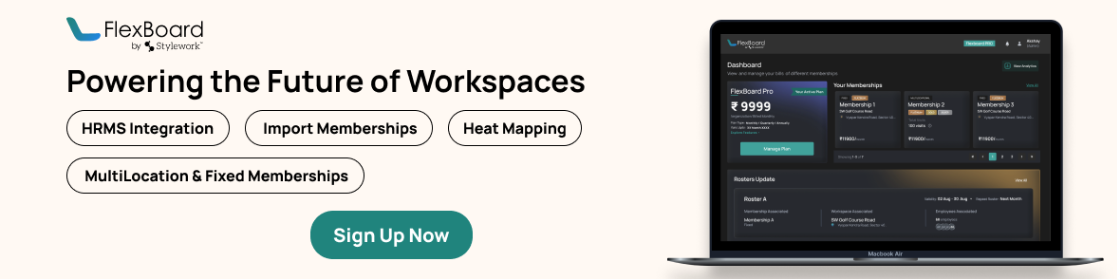
India’s hybrid work shift means employees need professional workspaces near their homes, not just near headquarters. The growing demand for coworking space in India has made multi-location memberships increasingly practical platforms like Stylework FlexBoard allow employees to work from any network location, reducing commute burden while maintaining professional productivity environments.
7. Sustainability
Shared infrastructure HVAC, power, internet, common areas means each occupier’s per-seat environmental footprint is meaningfully lower than a standalone office. Many operators are pursuing green certifications (LEED, IGBC) and solar energy installations.
8. A Faster, Lower-Risk Entry Point for GCCs
For GCCs, coworking space in India solves speed and risk rather than cost: a managed office lets a GCC sign one agreement, occupy a branded floor, and start hiring within weeks of board approval then convert to a direct lease later once scale and location are proven. This is a major reason GCCs now account for nearly 40–45% of enterprise flex space demand in India, a share projected to approach 50% by 2027.
Drawbacks & Limitations of Coworking Space in India
No workspace model is perfect. The main trade-offs to weigh before committing:
- Limited privacy: Open hot desks and dedicated desks aren’t suited to confidential client work or HR discussions.
- Noise and distraction: Shared floors can disrupt deep-focus work during peak hours.
- Restricted customisation: Branding and layout changes are limited; server rooms or specialised lab setups need a managed office or traditional lease.
- Inconsistent quality: Standards vary across India’s hundreds of operators, especially budget options in Tier-2 cities.
- Cost inversion at scale: For 100+ seat teams on a 5+ year horizon, a direct lease can work out cheaper than coworking.
Coworking vs. Managed Office vs. Traditional Office
This is the most critical comparison for any business evaluating workspace options. The right choice depends on team size, growth trajectory, privacy requirements, and operational priorities.
| Factor | Coworking (Shared) | Managed Office (Private) | Traditional Lease |
|---|---|---|---|
| Setup Cost | Zero – move in ready | Low – operator fits out | High – ₹30L-₹1Cr+ |
| Upfront Deposit | 1-3 months rent | 3-6 months rent | 6-12 months rent |
| Contract Flexibility | Monthly to annual | 6 months – 3 years | 3-9 year leases |
| Privacy | Low to medium (open/cabin) | Full – dedicated floor | Full |
| Branding / Customisation | Limited | Moderate to full | Full |
| Scalability | Very high | High | Low |
| Included Amenities | Full – internet, F&B, housekeeping | Full + custom infra | DIY – tenant manages all |
| Prime Location Access | Yes – at lower cost | Yes | Only if budget allows |
| Best For | Startups, freelancers, SMEs, hybrid teams | Enterprises, GCCs, MNCs | Large corporates with stable, long-term needs |
| Time to Occupancy | Same day – 1 week | 2-6 weeks | 3-9 months |
Also Read: What is the Difference Between a Coworking Space and a Managed Office Space?
Who Should Use Coworking Space in India?
Freelancers & Independent Consultants
Coworking space in India provides professional infrastructure address, meeting rooms, reliable internet that remote work from home cannot replicate. As a flexible office space option, day passes and dedicated desks give freelancers structure, productivity, and credible client meeting venues without a long-term commitment.
Startups (0-50 Employees)
Early-stage startups benefit from zero-capex entry, flexible scale-up options, and community proximity to investors and co-founders. The rise of coworking space in India has made this growth path seamless as startups scale, they can upgrade from a shared office space desk to a private cabin to a managed floor, all within the same operator network.
SMEs Expanding to New Cities
For an SME entering Mumbai from Delhi, a managed office or private cabin eliminates the need to understand local real estate markets, negotiate leases, or hire a local facilities team. Flexible office space operators like Stylework provide ready infrastructure in 120+ cities with a single contract.
Enterprise & MNC Teams
Large enterprises use coworking for three specific use cases: (a) satellite offices near employee clusters to reduce commute; (b) project team hubs that need 6-12 months of space without long-term commitment; (c) overflow capacity during peak hiring or restructuring.
Global Capability Centres (GCCs)
India has over 1,700 GCCs and the number is growing. Managed offices within coworking ecosystems allow new GCCs to be operational in weeks, not quarters critical for organisations that need to demonstrate ROI quickly before committing to a direct lease.
Remote & Hybrid Workforce
Employees in hybrid work models typically 2-3 days in office, don’t need fixed dedicated seats. Multi-location coworking memberships let them book workspaces near their homes on the days they need to be in a professional environment, reducing both commute and real estate costs.
In short, whether the need is a flexible office space for a solo consultant or shared office space for a 50-person hybrid team, India’s coworking space ecosystem now has a product built for that specific use case.
Also Read: How India’s GCC Wave Is Redefining the Role of Flexible Workspace Operators
Top Cities and Leading Operators for Coworking Space in India
| City | Key Micro-Markets | Leading Operators |
|---|---|---|
| Bangalore | Whitefield, Outer Ring Road, Koramangala, HSR Layout, BG Road | WeWork, IndiQube, Awfis, BHIVE, Smartworks, Table Space, CoWrks |
| Mumbai | BKC, Lower Parel, Andheri, Powai, Thane | WeWork, Awfis, Smartworks, Regus, The Executive Centre, Stylework |
| Delhi NCR | Connaught Place, Aerocity, Jasola, Noida Expressway | WeWork, Awfis, Incuspaze, 91Springboard, AltF, Regus |
| Gurgaon | Cyber City, Golf Course Road, Sohna Road, MG Road | WeWork, Smartworks, IndiQube, The Circle.Work, iSprout, CoWrks |
| Hyderabad | HITEC City, Gachibowli, Kondapur, Nanakramguda | WeWork, IndiQube, Table Space, DevX, The HQ, Awfis |
| Pune | Hinjewadi, Kharadi, Baner, Viman Nagar | WeWork, Awfis, IndiQube, 315Work Avenue, UrbanWrk, DevX |
| Chennai | OMR, Guindy, Anna Salai, Ambattur | WeWork, Awfis, IndiQube, Regus, iSprout, Smartworks |
| Tier-2 (Emerging) | Indore, Lucknow, Ahmedabad, Coimbatore, Bhubaneswar | Awfis, 91Springboard, Incuspaze, DevX, IndiQube, Smartworks |
Legal Considerations for Coworking Space in India
Before signing a coworking membership agreement for any coworking space in India, here’s what to check on the legal and compliance front:
- Licence, not lease: Most coworking memberships are licence agreements, so members don’t get tenancy rights check the termination notice period (typically 30-90 days for managed offices).
- 18% GST applies: GST-registered businesses can claim Input Tax Credit on workspace fees; virtual offices are commonly used for GST registration in cities with no physical presence.
- Registered address use: Using a coworking address for ROC filings or GST registration requires the operator’s explicit permission, usually included in virtual office plans.
- Data security: Businesses handling sensitive data should negotiate dedicated VLAN internet and review access-control policies, or opt for private cabins over open floors.
- Lock-in and exit clauses: Managed offices often carry 6-12 month lock-ins with exit penalties and negotiate break clauses at 3 or 6 month intervals.
- Employee compliance: Occupiers remain responsible for Shops and Establishments Act compliance and state labour law filings, even inside a coworking space.
Hybrid Work & Coworking in India
India’s hybrid work model of employees splitting time between home, office, and third workspaces is the biggest structural demand driver for coworking in 2026. According to industry data, approximately 60% of Indian knowledge workers now operate on hybrid schedules, creating demand for flexible workspace access that traditional offices cannot cost-efficiently provide.
The Hub-and-Spoke Model
Large enterprises are increasingly adopting a hub-and-spoke workspace strategy: a primary headquarters (‘hub’) complemented by multiple smaller satellite offices or coworking memberships (‘spokes’) near where employees live. This model reduces average commute time, improves productivity, and cuts per-seat real estate costs by 20-35%.
Coworking Aggregators & Hybrid Work Platforms
Platforms like Stylework consolidate access to 4,500+ coworking locations across 120+ cities into a single subscription. Employees book seats, meeting rooms, or day passes through the app; HR and finance teams get consolidated billing, utilisation analytics, and cost centre reporting replacing the complexity of managing multiple vendor relationships.
Source: CBRE & FICCI, “Flex-plosion” (March 2026); Vestian Research, Flex Workspace Report (December 2025)
Also Read: Can Flex Workspaces Help You Meet ESG and Reporting Commitments
Future of Coworking Space in India (2026 & Beyond)
Tier-2 & Tier-3 City Expansion
With infrastructure development, reverse migration from metros, and improving internet connectivity, cities like Indore, Surat, Jaipur, Coimbatore, Bhubaneswar, and Chandigarh are witnessing 35-40% YoY growth in coworking supply. Operators are deploying lighter, lower-capex formats to serve these markets profitably.
Managed Offices as the Enterprise Default
The distinction between ‘coworking’ and ‘managed office’ is blurring. Enterprises no longer see coworking as merely a startup tool managed office within a coworking ecosystem is the preferred entry vehicle for MNCs and GCCs entering India or expanding their India footprint.
AI-Enabled Workspace Management
AI-powered occupancy sensing, predictive booking, personalised desk assignment, and real-time space utilisation dashboards are becoming standard. Operators that deliver granular workplace analytics to HR and real estate teams will command a premium.
Sustainability & Green Workspaces
LEED-certified coworking spaces, EV charging, solar-powered common areas, and zero-single-use-plastic policies are emerging as differentiators both for ESG-conscious enterprises and for talent attraction among younger employees.
Wellness-Integrated Workspaces
Fitness studios, meditation rooms, standing desk policies, biophilic design, and mental health programming are moving from premium differentiator to standard expectation among enterprise and high-growth startup occupiers.
How to Choose the Right Coworking Space in India
Use this decision framework to evaluate and shortlist workspace options:
| Decision Factor | Questions to Ask |
|---|---|
| Team Size & Growth | How many seats do I need now? What’s my 12 month headcount plan? Can the operator scale me within the same building? |
| Location | Is it accessible to my team via public transport? Is it close to client offices? Is the micro-market appropriate for my business identity? |
| Budget | What is my per-seat monthly budget including GST? Have I factored in meeting room usage, parking, and additional services? |
| Privacy Requirements | Do I handle sensitive data? Do I need NDA protected meeting rooms? Do clients visit regularly? |
| Flexibility Needs | Is my team fully in-office or hybrid? Do I need multi-city access? Do I need a rolling contract or can I commit to 12 months? |
| Operator Quality | What is the internet uptime SLA? How responsive is on-site support? What do Google/JustDial reviews say about facility quality? |
| Amenities | Does the space have 24/7 access? Is there a cafeteria or pantry? Are meeting room credits sufficient for my team’s needs? |
| Legal & Compliance | Does the agreement allow GST registration? What is the lock-in period? What are the exit clauses? |
Running this checklist across even three or four operators in a single city is time-consuming and it multiplies fast if you’re evaluating multiple cities at once. This is where Stylework simplifies the process: instead of visiting each operator’s website and negotiating separately, you compare verified pricing, amenities, and availability across thousands of locations in one place, then book and manage everything under a single agreement.
Conclusion
The market of coworking space in India is no longer an alternative, it is the mainstream. Whether you are a freelancer looking for your first professional workspace, a startup scaling from 5 to 50 seats, an SME expanding into a new city, or a multinational deploying a GCC, India’s flexible workspace ecosystem in 2026 has the right product at the right price point.
The key is matching the workspace type to your actual requirements: hot desks for flexibility, dedicated desks for routine, private cabins for teams, managed offices for enterprise privacy, and virtual offices for compliance without commitment.
With over 110 million sq ft of flexible workspace across 120+ cities and platforms FlexBoard making multi-location access as simple as a single subscription there has never been a better time to move beyond the traditional office and into India’s growing flexible workspace economy.
Frequently Asked Questions
How much does a coworking space cost per month in India?
Coworking costs in India vary by city and workspace type. A dedicated desk ranges from ₹6,000-₹22,000/month. A 4 seat private cabin ranges from ₹18,000-₹65,000/month. Managed office pricing is negotiated based on headcount and is typically ₹10,000-₹30,000 per seat per month in Tier-1 cities. All prices are subject to 18% GST.
Is coworking cheaper than a traditional office lease in India?
For most businesses with fewer than 50 seats and a horizon under 3 years, yes significantly so. Coworking eliminates the ₹30L-₹1Cr+ upfront fit-out cost, reduces security deposits from 6-12 months to 1-3 months, and transfers all operational costs (housekeeping, internet, maintenance) to the operator. For very large, stable teams (200+ seats, 5+ year tenure), a direct lease with a managed service provider may be more economical at scale.
Can I use a coworking space address for GST registration in India?
Yes, provided the coworking operator’s membership agreement explicitly permits use of the address for GST registration, ROC filings, and business correspondence. Virtual office plans are specifically designed for this purpose and typically include a GST registration NOC. Always verify with your CA that the address meets the jurisdiction’s requirement for your business category.
What is a managed office space and how is it different from coworking?
A managed office is a private, customised office floor or unit within a professionally managed building, operated on behalf of the occupier. Unlike a shared coworking floor, a managed office is exclusive to one company, can be branded, and typically includes custom layouts and dedicated infrastructure. It combines the privacy of a traditional lease with the zero-setup, all-inclusive model of coworking.
Which city in India has the best coworking spaces?
Bangalore has the largest coworking market by supply and the most operator diversity, making it the top market overall. Mumbai leads on premium managed office and enterprise demand. Delhi NCR offers the widest range across price points. Hyderabad and Pune are preferred by tech companies for their cost efficiency relative to supply quality. The ‘best’ city depends on where your talent is, not just which market is largest.
Are coworking spaces good for large companies and enterprises?
Increasingly, yes. Over 40% of coworking and managed office space absorption in India’s Tier-1 markets now comes from enterprises with 50+ employees. Large companies use coworking and managed offices for satellite offices near employee clusters, project team hubs, GCC entry strategies, and hybrid workforce hub-and-spoke models all without the capital commitment or operational burden of a direct lease.
What amenities should I look for in a coworking space in India?
Minimum viable: high-speed internet with backup, meeting rooms, 24/7 access, biometric security, housekeeping, and pantry. Premium indicators: dedicated VLAN internet, AV-equipped conference rooms, concierge services, business-grade CCTV, EV charging, and wellness amenities. For enterprises: check for occupancy analytics, multi-city access, and a dedicated account manager.
How does hybrid work affect coworking space demand in India?
Hybrid work is the single largest demand driver for coworking in India. As companies reduce their fixed desk ratios typically from 1 desk per employee to 0.6-0.8 desks per employee they need flexible supplementary workspace near where employees live. Multi-location coworking memberships and aggregator platforms like Stylework’s FlexBoard solve this by giving employees access to professional workspace across hundreds of locations, on-demand, on the days they need it.