
 Afsha
Applying for GST registration requires businesses to provide valid address proof for GST registration to establish their Principal Place of Business (PPOB). This address helps establish where the business operates or maintains its records and allows GST authorities to verify the declared premises.
However, the documents required for GST registration depend on the type of property you use. An owned office, rented property, shared workspace and virtual office may each require a different set of supporting documents.
A virtual office is another option for businesses that need a professional business address without renting a dedicated commercial office. However, businesses considering a virtual office for GST registration should check the provider’s documentation, property ownership proof and permission to use the premises before applying.
An incomplete rent agreement, missing ownership proof, an unsigned consent letter or a mismatch in the property address can lead to a clarification notice and delay your GST registration.
This guide explains the GST registration address proof requirements, documents needed for different property arrangements, common documentation mistakes and practical tips to help you prepare your application correctly.
Why is Address Proof Required for GST Registration?
When applying for GST registration, businesses must declare their Principal Place of Business (PPOB). It is the primary location from which business activities are carried out or business records are maintained.
The GST authorities use the declared address to:
- Verify the location associated with the GST registration.
- Establish that the applicant has the right to use the premises.
- Communicate with the registered business.
- Conduct physical verification of the premises where required under GST rules.
The address entered in Form GST REG-01 must be supported by relevant property documents. These documents establish the ownership of the premises or the applicant’s permission to use the address. This is why providing valid proof of Principal Place of Business is an important part of the GST registration process.
Pro Tip: Before starting your GST application, collect your property documents and check the complete address on each one. Matching the building name, unit number, floor, locality and PIN code can help prevent avoidable clarification requests.
Documents Required for GST Registration: Quick Checklist
The GST address proof documents vary according to the type of premises and the applicant’s arrangement with the property owner.
| Type of premises | Main document | Supporting document |
|---|---|---|
| Owned property | Ownership proof, such as property tax receipt or municipal khata | Applicable utility bill or other supporting property record |
| Rented or leased property | Valid rent or lease agreement | One qualifying ownership document of the lessor |
| Unregistered rent agreement | Rent or lease agreement | Ownership proof and lessor’s identity proof |
| Shared or consent-based premises | Consent letter or NOC, where applicable | One ownership document and identity proof of the person granting consent |
| Virtual office | Agreement or consent document applicable to the arrangement | Supporting ownership and property-address documents |
The exact document combination depends on the nature of possession and the arrangement between the applicant and property owner.
CBIC Instruction No. 03/2025-GST, issued on 17 April 2025, provides guidance on the documents expected for different types of premises.
Address Proof for GST Registration for Owned Property
If your business operates from a property that you own, you need to submit a document establishing ownership of the premises. These documents form an important part of the GST registration address proof.
The following documents may be used as ownership proof, subject to the applicable requirements:
- Latest property tax receipt
- Municipal khata copy
- Electricity bill
- Water bill
- Ownership deed or sale deed
- Similar documents recognised under applicable state or local laws
The document should clearly identify the property and support the address declared in your GST application.
What Should You Check Before Submitting?
- The property document should relate to the premises declared in the application.
- The address should be complete and consistent.
- The document should be readable, with all relevant details visible.
- If you use a utility bill, check that it identifies the same premises.
Pro Tip: Use a clear and recent property document wherever possible. Before uploading, check whether the property number, building name, floor and PIN code match the details entered in the GST portal. Do not rely on an old or incomplete address document when a more recent supporting record is available.
Also Read: What Challenges Do Entrepreneurs Face while Running a Business
Address Proof for GST Registration for Rented or Leased Property
If you operate your business from a rented or leased office, you need to establish your right to use the property and provide supporting ownership proof. The address proof for GST registration for rented property generally includes a rent or lease agreement and supporting property documents.
The documents depend on whether your rent or lease agreement is registered.
Documents Required for a Registered Rent or Lease Agreement
You should generally prepare:
- Registered rent or lease agreement: It should mention the property address, parties involved and applicable terms.
- Ownership proof of the lessor: One qualifying document, such as a property tax receipt, municipal khata or electricity bill.
Under CBIC Instruction No. 03/2025-GST, a separate identity proof of the lessor should not be required when a valid registered rent or lease agreement and qualifying ownership proof are submitted.
Documents Required for an Unregistered Rent Agreement
For an unregistered rent or lease agreement, the expected documents include:
- Rent or lease agreement.
- One qualifying ownership document of the lessor.
- Identity proof of the lessor.
The applicant should ensure that the agreement and supporting documents relate to the same premises.
Is an NOC Required for Rented Premises?
A separate NOC for GST registration or consent letter is generally not required when a valid registered rent or lease agreement is submitted.
For unregistered rental arrangements, a consent letter or NOC may be relevant depending on the documentation and circumstances. Follow the applicable requirements under the GST registration instructions.
Pro Tip: Ask your landlord for the property ownership document before finalising the agreement. Check that the landlord’s name and property address are consistent across the agreement and supporting proof. If the agreement is unregistered, arrange the required identity proof in advance rather than waiting for a clarification notice.
Address Proof for GST Registration for Shared or Consent-Based Premises
Not every business has a dedicated office or a formal rental agreement. Some businesses operate from premises owned by a family member, use shared commercial premises or have permission to use another person’s property.
In these cases, the applicant may need to submit a consent letter for GST registration or No Objection Certificate (NOC), along with the relevant supporting documents.
Also Read: How Coworking Spaces Are Changing the Way People Travel and Work
What Is a Consent Letter or NOC for GST Registration?
A consent letter is written permission from the property owner or authorised person allowing the applicant to use the premises as a place of business.
It establishes that the applicant has permission to use the declared address. It does not transfer ownership of the property.
What Should a GST Consent Letter Include?
A consent letter should clearly mention:
- Full name of the property owner or person granting consent.
- Complete address of the property.
- Name of the business applying for GST registration.
- A clear statement permitting the business to use the premises.
- Date of consent.
- Signature of the person granting permission.
Supporting Documents
Depending on the arrangement, you may need:
- Signed consent letter or NOC.
- Identity proof of the person granting consent.
- One qualifying ownership document, such as an electricity bill, property tax receipt or municipal khata.
Pro Tip: Do not use a generic NOC downloaded from the internet without checking its details. Make sure it identifies the correct business, property owner and complete premises address. The supporting ownership document should refer to the same property mentioned in the consent letter.
Can You Use a Virtual Office Address for GST Registration?
Yes, a virtual office address for GST registration may be used when the arrangement meets the applicable requirements and the business has valid supporting documentation.
A virtual office allows businesses to establish a professional business address without renting or maintaining a full-time physical office. It is particularly useful for startups, freelancers, consultants, e-commerce sellers and companies planning to expand into new cities.
Apart from providing a business address, a virtual workspace can help businesses manage office-related costs and establish a presence in different locations. However, GST registration requires valid address documentation, and the provider must be able to support the applicant with the applicable property-related documents.
For GST documentation, a virtual office is generally assessed under the applicable rented, leased or consent-based premises arrangement. It is not a separate category that automatically removes the need for property documents.
Businesses considering this arrangement can read our detailed guide on benefits of using a virtual office for GST registration in India to understand how a virtual office can support their business address requirements.
Also Read: Coworking Space in India: Costs, Benefits & How to Choose the Right One (2026)
Documents to Check Before Selecting a Virtual Office
Before choosing a virtual office for GST registration, confirm which documents the provider can supply.
| Document | Purpose |
|---|---|
| Rent, lease or service agreement, as applicable | Establishes the applicant’s arrangement and right to use the address |
| NOC or consent letter, where applicable | Records permission to use the premises |
| Property ownership proof | Supports the ownership of the premises |
| Electricity bill or other qualifying property document | Helps establish the property address |
| Complete address details | Ensures consistency with the GST application |
The precise document combination depends on the legal arrangement and supporting records available for the property.
If you are planning to register a new business, you can also read our guide on how to get a virtual office address for company registration. It explains how businesses can explore a virtual office address for their company registration requirements.
Who Can Benefit from a Virtual Office?
- Startups: A virtual office helps startups establish a professional business address without committing to a full-time commercial office. It can also help manage initial office expenses while building a business presence. Learn more about the benefits of a virtual office for startups.
- Freelancers and consultants: Use an appropriate business address instead of relying on a personal residential address, subject to applicable requirements.
- E-commerce sellers: Explore address options for eligible GST requirements in different states, including situations involving additional places of business.
- Growing companies: Establish a presence in another city without leasing an entire office.
- Small businesses: Reduce the need for a traditional office when their operations do not require dedicated workspace.
A virtual office can also provide flexibility in managing business operations. Read more about the advantages of a virtual workspace to understand how this arrangement can support different business requirements.
What Should You Verify Before Purchasing a Virtual Office Plan?
- Does the provider have the authority to offer the selected premises?
- Can the provider supply the applicable agreement or consent document?
- Is ownership or other qualifying property proof available?
- Is the complete address consistent across the documents?
- Can the provider explain the process for handling official communication or physical verification, if required?
- Does the plan support your intended registration purpose?
Pro Tip: Do not select a virtual office based only on its location or price. Ask for a clear list of the documents included in the plan and confirm that they support your intended GST registration. A virtual office provider can supply address-related documents, but the final registration decision rests with the GST authorities.
Common Mistakes That Can Delay or Affect GST Registration
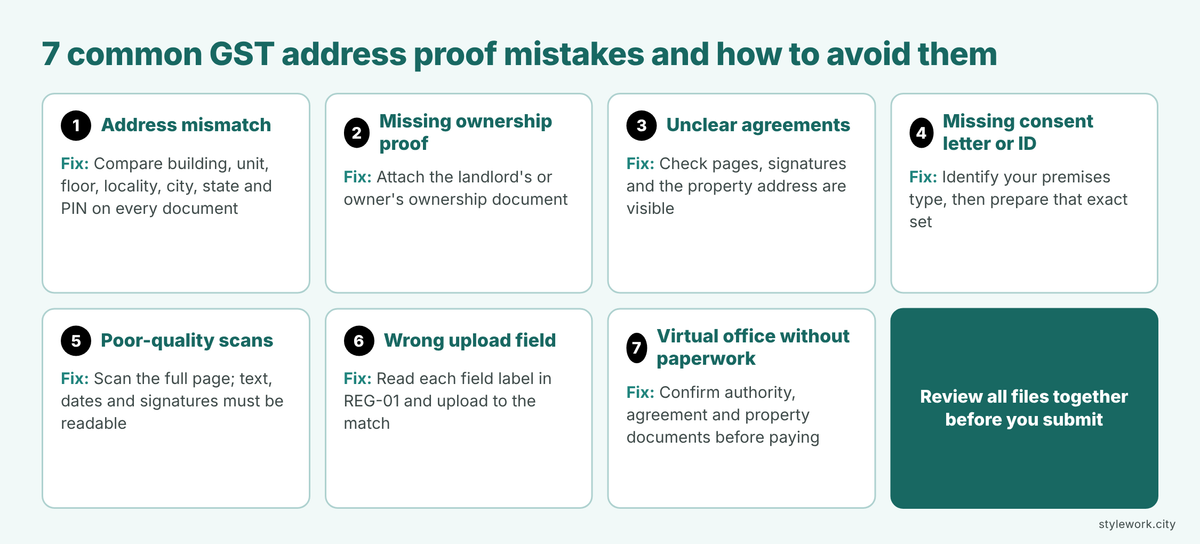
Even when you have the required documents, small errors can create problems during verification.
Here are some common issues to check before submitting your application.
1. Address Mismatch Across Documents
The address in the GST application may differ from the rent agreement, consent letter or ownership proof.
How to avoid it: Check the building name, office number, floor, locality, city, state and PIN code across all documents.
2. Missing Ownership Proof
Submitting only a rent agreement or consent letter may not establish the ownership of the premises.
How to avoid it: Attach the applicable ownership document of the lessor or person granting consent.
3. Incomplete or Unclear Agreements
Missing signatures, an unclear property address or incomplete agreement details can create verification issues.
How to avoid it: Review the agreement before uploading it. Ensure that the relevant pages, signatures and property details are visible.
4. Missing Consent Letter or Identity Proof
For certain shared or unregistered rental arrangements, the required consent or identity document may be missing.
How to avoid it: Identify the exact type of property arrangement and prepare the applicable supporting documents.
5. Poor-Quality Document Scans
Blurred images, cropped pages and unreadable property details can make verification difficult.
How to avoid it: Scan the complete document and check that all text, dates, signatures and addresses are readable.
6. Incorrect Document Uploaded in the Wrong Field
The GST registration form has different fields for the relevant property documents. Uploading the wrong document in a particular field can create confusion.
How to avoid it: Review the document labels in Form GST REG-01 and upload each file in the relevant field.
7. Choosing a Virtual Office Without Checking Documentation
A virtual office provider may offer an address but not the complete documentation required for your particular arrangement.
How to avoid it: Confirm the provider’s authority, agreement terms and supporting property documents before making a payment.
Pro Tip: Create one folder containing your rent agreement, consent letter, ownership proof, identity documents and final address details. Review the files together before submitting the GST application. This makes it easier to identify missing or inconsistent information.
What Does CBIC Instruction No. 03/2025-GST Say About Address Proof?
CBIC issued Instruction No. 03/2025-GST on 17 April 2025 to provide clearer guidance for processing GST registration applications.
The instruction addresses issues related to unnecessary document requests and inconsistent verification practices.
For GST registration address proof, it clarifies the expected documentation for different types of premises.
| Property arrangement | Documentation guidance |
|---|---|
| Owned premises | One qualifying ownership document |
| Registered rent or lease agreement | Agreement and one qualifying ownership document of the lessor |
| Unregistered rent or lease agreement | Agreement, ownership proof and lessor’s identity proof |
| Consent-based premises | Consent letter, identity proof of the person granting consent and one qualifying ownership document |
The instruction also guides GST officers against seeking additional documents without a relevant basis when the prescribed documents have been submitted.
Why Is This Important for Applicants?
It helps businesses understand which documents are generally expected for their property arrangement. It also provides clarity when an applicant receives requests for additional documents that may not be necessary under the applicable instructions.
Pro Tip: If you receive a clarification request for additional documents, read the notice carefully and check it against CBIC Instruction No. 03/2025-GST. Respond to the specific issue raised rather than uploading unrelated documents. If the request appears inconsistent with the prescribed requirements, consult a GST professional before responding.
What Should You Do If You Receive a GST Registration Clarification Notice?
If the GST officer requires additional information or clarification, you may receive a notice in Form GST REG-03, also known as a GST REG-03 clarification notice.
A clarification notice does not automatically mean that your application has been rejected. It means the officer requires further information or documents to process the application.
Follow these steps:
- Log in to the GST portal and check your application status.
- Open Form GST REG-03 and read the clarification requested.
- Identify whether the issue relates to the address, rent agreement, consent letter or ownership proof.
- Arrange the relevant supporting documents.
- Submit your response through the applicable form, generally Form GST REG-04, within the prescribed time.
- Save a copy of your submitted response and supporting documents.
Pro Tip: Do not submit the same document repeatedly without addressing the actual issue raised in the notice. If the officer has pointed out an address mismatch, provide the corrected details or supporting explanation. Make sure your response directly addresses each clarification.
Final GST Address Proof Checklist Before Applying
Use this GST registration documents checklist to review your documents before submitting your application.
- The Principal Place of Business address is complete.
- The address matches the supporting property documents.
- The rent or lease agreement is valid, where applicable.
- The required ownership proof is attached.
- The consent letter or NOC is included, where applicable.
- The identity proof of the lessor or person granting consent is included where required.
- All relevant pages and signatures are visible.
- The uploaded documents are readable and meet the GST portal’s current file requirements.
- The virtual office provider, if used, has confirmed the required documentation and authority to provide the address.
- The application details have been reviewed before final submission.
A final document check can help reduce avoidable clarification requests and filing delays.
Frequently Asked Questions About Address Proof for GST Registration
1. Which Documents Are Accepted as Address Proof for GST Registration?
The accepted address proof for GST registration depends on the type of premises. Owned properties can be supported by qualifying ownership documents such as a property tax receipt or municipal khata. Rented properties generally require a rent or lease agreement and ownership proof of the lessor. Shared or consent-based premises may require a consent letter, identity proof and ownership proof.
2. Can I Apply for GST Registration Without Owning an Office?
Yes. You do not necessarily need to own an office to apply for GST registration. You may use rented, leased or eligible shared premises, provided you have the required documents establishing your right to use the address.
3. Is a Rent Agreement Mandatory for GST Address Proof?
A rent agreement for GST registration is generally required when the premises are rented or leased. For certain consent-based arrangements, a consent letter and supporting ownership documents may be applicable instead. The correct documents depend on the nature of possession.
4. Is an NOC Required for GST Registration?
An NOC for GST registration or consent letter may be required when the applicant uses premises with the owner’s permission rather than under a qualifying rent or lease agreement. A separate NOC is generally not required when a valid registered rent or lease agreement and the applicable ownership proof are submitted.
5. Can I Use a Virtual Office Address for GST Registration?
Yes, a virtual office address for GST registration may be used when the arrangement meets applicable GST requirements and the provider can supply valid supporting documents. Confirm the agreement, consent or NOC where applicable, property proof and the provider’s authority before selecting a plan.
6. Can I Use My Home Address for GST Registration?
A residential property may be used as a business address where the applicant has the necessary right to use the premises and provides the applicable documents. The suitability also depends on the nature of the business and other applicable legal requirements.
7. What Happens If My GST Address Proof Is Incorrect?
If the submitted GST address proof documents are incomplete, unclear or inconsistent, the GST officer may issue a clarification notice in Form GST REG-03. If the applicant does not provide a satisfactory response within the prescribed time, the application may be rejected.
8. Can I Use the Same Virtual Office Address for Multiple Businesses?
This depends on the actual premises, the provider’s authority, the consent or agreement arrangements and the requirements applicable to each applicant. Each business must have valid supporting documentation for its own GST application.
9. Does a Virtual Office Guarantee GST Registration Approval?
No. A virtual office for GST registration provider can supply address-related documents and support the process, but GST registration approval is decided by the relevant tax authorities. The applicant remains responsible for submitting accurate information and meeting applicable requirements.
10. How Can I Avoid Rejection of GST Registration Due to Address Proof?
Use a genuine and verifiable business address, submit the correct agreement or consent document, attach the applicable ownership proof and ensure that all address details match. Review the application and uploaded documents before submission.
Conclusion
Address proof for GST registration is an important part of the GST application process, whether your business operates from an owned office, rented premises, shared workspace or virtual office. The documents required for GST registration depend on the property arrangement, so it is important to understand the requirements before applying.
Check the latest GST registration guidelines, ensure that your property details are consistent and submit clear, complete supporting documents.
If you do not have a dedicated commercial office, a virtual office for GST registration may be an option worth exploring. Check the provider’s documentation, ensure that the property details are consistent and confirm that the arrangement supports your intended business purpose.
Looking for a Virtual Office for GST Registration?
Stylework helps businesses explore virtual office options across multiple Indian cities. Choose a location that suits your business requirements and check the applicable address documentation before selecting a plan.
With the right business address and supporting documents, you can prepare your GST registration application with greater clarity.